US midterms – special issue
Tech enters correction territory after US voters rebuke Trumpism & AI
For a change, a US election followed the trajectory of the polls when the Democrats swept back control of Congress and the Senate. The initial market response on Wednesday was positive when it became clear that Trump wouldn’t contest the results. But on Thursday we saw the biggest one-day tech sell off since “Liberation Day” after investors remembered that AI was also under proper democratic scrutiny for the first time.
Of the 47 data centre moratoriums or restrictions that were on the ballet, 46 were approved. The only exception came from voters in the small town of Harwood, North Dakota (pop. 940). Voters in California, Ohio and Illinois, (states ranked fourth, fifth and sixth for total number of data centres in the US) voted resoundingly against plans to build more, in some districts by as much as 80%.
Aside from the practical implications of limiting data centre buildouts, prospects for AI and big tech were dealt a blow by the sheer number of young and progressive victorious Democratic candidates. OpenAI, Anthropic and Nvidia have significantly ramped up their lobbying spending over the last two years, but that money is likely to be wasted on the likes of Senator-elect for Texas (the state with the most data centres) James Talarico or the Bernie Sanders aligned Senator-elect for Michigan, Abdul El-Sayad. Making matters worse, the favourite to lead the Democratic party in 2028, Senator for Georgia Jon Ossoff, significantly increased his vote share after only narrowly winning his seat in 2021. In April, Ossoff launched an investigation into the impact of data centres on power bills in Georgia and has been an outspoken critic of the use of AI to deny medical insurance claims. He made it clear in his victory speech that he’s “committed to continuing the work of bringing big pharma, big insurance and big tech to heel”.
Even prior to 2028, the changing makeup of Congress and the Senate opens doors for some landmark bills to pass and a raft of committee hearings to start. Renowned critic of the tech industry, Senator Elizabeth Warren, is expected to lead the Senate Banking Committee. In September Warren called for a pause in AI development while a new agency is set up to regulate big tech and AI. It also gives Sanders’ “Ban Artificial Superintelligence Act” a chance of passing if resubmitted in January. As my colleague Richard said this time last year, building “superintelligent” AI is the primary aim of all the debt raising and spending, and investors are increasingly questioning whether valuations can be justified or if credible routes to actual net profits can be found through what Large Language Model (LLM) based AI currently offers. Other investigations and committee hearings may include focuses on AI model training data and intellectual property theft; the impact of chatbots on mental health and their culpability in various mass shootings and suicides; and the actions of Elon Musk’s Department of Government Efficiency (DOGE), raising additional concerns for SpaceX and Tesla investors.
Outside of the politics, we also saw another PR gaffe from OpenAI’s Sam Altman. On the Cheeky Pint podcast, Altman said it was “terrible” for people to have RAM at home because it should be prioritised for “maximum utilization in the cloud”, sparking viral memes of derision and disdain early in the week. With Trump’s power to protect the frontier labs curtailed, it’s more important than ever for the labs to avoid unnecessary mishaps and start winning some favour from the public. And in a classic example of trying to bury unfavourable news while something else is going on, Anthropic released their amended S-1 filing on Monday evening. The file was updated to include their Q3 numbers and as widely expected, showed a revenue growth slowdown following the end of “token maxing” and even more compute spending commitments, taking the new total to $895bn. By the end of the week, some large investors were reportedly telling Anthropic that they’ve lowered their IPO valuation down from $2tn to around $1.5tn.
The fall on Thursday was largely started by hedge funds selling off leveraged long positions in AI and big tech. In total $2.5tn in market value was wiped off the US’s main tech index. Despite this, and what is now four weeks of declines in a row, if you look at the CAPE ratio, a useful valuation metric for assessing whether something is over or under valued, the US market still has a long way to go before valuations reach more rational levels. On Friday, we saw a massive sell off in Asian and Emerging Markets (EM) as the negative sentiment hurt key parts of the AI chain like, Samsung Electronics and SK Hynix. After the Asian markets shut, we did see a rebound in the US, with retail investors being credited for dragging the tech index back up 1.09%.
In terms of our own portfolios and our view on the outlook, we’ve been underweight in the US and big tech for some time and nothing has happened to change our stance. The market is heavily concentrated around a small number of firms raising huge amounts of debt to chase something that may not be possible or, if achieved, accepted by the public and policy makers. We are more exposed through Asia and EM due to AI supply chain stocks making up so much of the indexes, but tech in Asia appears to be trading at discounts compared to US counterparts, and we still believe in the opportunities posed by the corporate reforms taking place in countries like South Korea. At the end of October our Risk Barometer had its largest swing downwards since Trump’s tariffs, falling 14 points to +0.47. While still in positive territory, it is, in our view, an indicator that investors need to be extra selective and thoughtful when searching for alpha in current market conditions.
Midterms spill over in UK market & oil prices
Our home market was on for a positive week until the US markets opened on Thursday and the risk-off attitude spilled into other regions.
As expected, the Bank of England voted to raise interest rates for the first time in three years. The Bank’s Governor, Andrew Bailey, blamed the war in Iran and its impact on energy prices. The Bank expects inflation to peak next year at 4.9% though they warned it could go higher if things get worse.
Crude and brent oil prices fell around 12% this week after investors read Trump’s embattled demeanour as a sign that he may favour diplomatic ways to end the war in Iran. Reuters also reported that Iran sent a nuclear proposal to Washington via Qatari intermediaries.
However, hopes that Trump would listen to voters and tone down his policy agenda were dashed on Friday when Stephen Miller was promoted to replace Susie Wiles as Chief of Staff. Appointing Miller, responsible for Trump’s hardline immigration policy, indicates the administration has few plans to put any resolution to the conflict through Congress, keeping the outcome of the war down to Trump’s whims.
Coming up this week:
CoreWeave Quarterly earnings – Tuesday
AI and tech will come under the spotlight again when neocloud, CoreWeave, release their Q3 earnings on Tuesday. Shares in the company have fallen 55% since their last update. Investors will be assessing their mounting debt obligations, what impact the data centre votes will have on existing and future projects, and whether they’re getting near profitable revenue growth.
US inflation data – Tuesday
Following last week’s jobs report which showed US unemployment went down slightly to 4.1%, all eyes will be watching Tuesday’s Consumer Price Index (CPI) report to see if inflation has risen once again. Coupled with the latest jobs numbers, a rise in inflation will increase the odds of a rate hike in December, putting more pressure on AI and the tech sector.
Notice:
For regulated financial advisers and investment professionals only, Copia does not provide financial advice, and the contents of this document should not be taken as such.
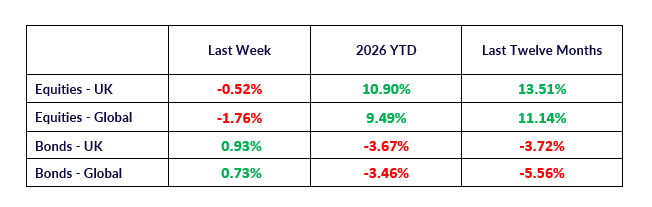
The performance of each asset class is represented by certain Exchange Traded Funds available to UK investors and expressed in GBP terms selected by Copia Capital Management to represent that asset class, as reported at previous Thursday 4:30pm UK close. Reference to a particular asset class does not represent a recommendation to seek exposure to that asset class. This information is included for comparison purposes for the period stated but is not an indicator of potential maximum loss for other periods or in the future.