The infoshot to help kick-start your week
Coming up this week:
Fed interest rate decision – Wednesday
Following the latest inflation data from the Bureau of Labor Statistics, which showed PPI increased 0.4% in August and CPI remained high at 3.4%, the odds of a Federal Reserve rate hike have increased to 85%. In a little under a month, the odds have gone from around 50% to a near-certainty. If the Fed doesn’t increase rates, it’s likely to raise some serious questions about its independence and credibility, potentially driving US Treasury yields to record highs.
BoE interest rate decision – Thursday
Here in the UK, the Bank of England (BoE) is expected to hold rates at 3.75% on Wednesday. Three of the Bank’s nine committee members voted to hike rates at the last meeting, and it’ll be interesting to see if that changes. Inflation is set to be forced upwards when Ofgem’s next price cap starts in October sending household energy bills up 4%. The UK’s better-than-expected recent economic growth coupled with persistently rising energy prices might prompt more committee members to vote for a hike in the autumn months.
BoJ interest rate decision – Friday
With the yen’s recent improvement, the Bank of Japan (BoJ) are expected to raise interest rates to 1.25%, the highest they’ve been for more than 30 years. US Treasury Secretary, Scott Bessent, said on Tuesday he expects Japanese interest rates to rise after the US Treasury intervened in exchange markets to prop up the yen in July.
Last week:
Oil hits $100 a barrel sending markets downwards
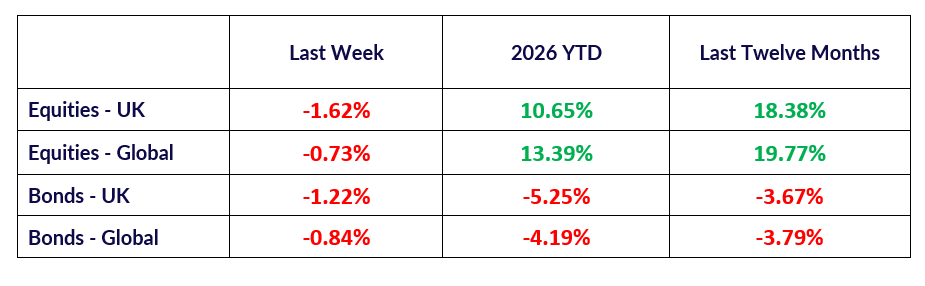
Markets across the globe fell as the price of crude oil rose above the $100 mark for the first time since May. On Thursday, Saudi Arabia had to suspend operations through its East-West pipeline after a Houthi drone strike. Saudi oil traders have said they will run out of oil exports if the pipeline doesn’t reopen within days, hampering around 4% of the global oil supply. Yesterday, the Houthis also captured the island of Perim expanding their control of the Bab al-Mandab strait.
Supply pressures forced US retailer Costco to start limiting how much motor oil consumers can buy to 40 gallons per week. While that won’t have much impact on regular consumers, it will hit small businesses and farmers who rely on buying the product in bulk.
With no end in sight to the conflict in Iran, the prospect of further domestic inflation and his polling numbers falling through the floor, President Trump used his speech at the Republican midterm convention to urge his supporters to “cheat like hell” and promised a $5,000 “dividend” to all US adults if the Republicans manage to win the House of Representatives and the Senate.
Existential threat from superintelligence dominates headlines
US AI firms were put firmly back in the spotlight following viral posts by former Anthropic and OpenAI employee, Jacob Coxon. While short on detail, Coxon’s posts on the existential threat posed by superintelligence rapidly raked in 100mn views, secured him spots on several major news networks and have dominated the headlines since.
This has led to fresh calls for more regulation and oversight from across the political spectrum, with immediate controls around recursive learning (the ability for AI to self-improve through its own coding) and chain of thought experiments (allowing AI to write reasoning logic in a format we can’t understand) top of the agenda. During his trip to Ireland, Trump dismissed those calls saying critics were “bringing up things that won’t happen”. People hoping for a slowdown in the push for superintelligence, will be praying something comes out of the next US-China summit in Washington on 24 September as it’s clear the current US administration will stop at nothing in the race with China.
From an investing perspective, the existential threat posed by superintelligent AI has been clearly articulated many times over the last few years (see “If anyone builds it…” or any interview with Nobel Prize winning “Godfather of AI”, Geoffrey Hinton), and as political and public pressure grows, we may see a global pause or halt which would dramatically change the current market outlook, especially in the US and certain parts of Asia. All the data centre buildouts and debt spending have effectively been to fuel the race towards superintelligence, and it’s looking increasingly unlikely the current outputs from US ‘Large Language Models’ (LLMs) will ever reach any form of profitability if they remain where they are today. In our view, what we’ve seen this week has only added support for the case of prioritising diversification and being wary of US big tech and AI hyperscalers.
ECB increase rates, while concerns grow over the future of Europe’s largest economy
The European Central Bank (ECB) raised interest rates in line with expectations on Wednesday. Markets are predicting two more rate hikes before the end of the year. The ECB blamed the conflict in Iran for pushing up inflation and said, “inflation is set to remain well above target for an extended period.”
In German bond markets, the far-right Alternative for Germany’s (AfD) election win in Saxony-Anhalt sent the 10-year Bund yield close to a 15-year high. The AfD didn’t win an overall majority, but their rapid rise is raising serious questions about the prospects for Europe’s largest economy. After Trump congratulated the AfD, the embattled German Chancellor, Friedrich Merz, cancelled his scheduled call with the US president and accused the AfD of seeking “ethnic cleansing” and said their “remigration” policies will destroy the German economy.
Notice:
For regulated financial advisers and investment professionals only, Copia does not provide financial advice, and the contents of this document should not be taken as such.
The performance of each asset class is represented by certain Exchange Traded Funds available to UK investors and expressed in GBP terms selected by Copia Capital Management to represent that asset class, as reported at previous Thursday 4:30pm UK close. Reference to a particular asset class does not represent a recommendation to seek exposure to that asset class. This information is included for comparison purposes for the period stated but is not an indicator of potential maximum loss for other periods or in the future.