
The infoshot to help kick-start your week
Fed interest rate left unchanged before Warsh nomination
Despite pressure from President Trump, the Federal Reserve voted to keep its key lending rates unchanged at 3.5% to 3.75%. The Fed’s statement was quite positive on the state of the US economy, saying activity has been “expanding at a solid pace” and that while new jobs have “remained low”, “the unemployment rate has shown some signs of stabilisation.”
On Friday, Trump nominated Kevin Warsh to replace the outgoing Jerome Powell as the new Fed Chair. Warsh worked as a Fed governor from 2006 and 2011. He’s been an open critic of the Fed in recent years, claiming in April last year that fiscal policy had been on a “dangerous trajectory” following a rise in “irresponsible spending” after the covid pandemic. He’s also criticised the bank for getting involved in “politically charged issues” like climate change and DEI. Before he can start work, Warsh will have to be vetted and confirmed by the Senate. His ties with close Trump friend, and the man who reportedly inspired the US president’s interest in Greenland, Rene Lauder (Warsh is married to Lauder’s daughter), and the DoJ’s criminal investigation into Jerome Powell could hold up the process.
Over the years, Warsh has backed maintaining higher interest rates, and the perception of him as a relatively safe choice had a big knock-on effect on gold prices. Gold topped $5,600 an ounce on Thursday but came tumbling back down to just below $4,900 on Friday as investors sold off based on Warsh potentially being less likely to cave into Trump’s demands for lower interest rates. Lowering rates inappropriately could lead to higher inflation and an even weaker dollar. Earlier in the week, the dollar fell to its lowest level in four years. Trump’s comments that he thinks the dollar’s decline is “great” sparked Wednesday’s gold price surge.
Eurozone economy beats forecasts
The latest economic data from the European Commission showed the Eurozone economy grew 1.5% in 2025, beating their 1.3% forecast. GDP increased by 0.3% in the final quarter of last year with Ireland the only nation posting a decrease (-0.6%) compared to Q3.
Interestingly, Spain’s economy led the way, growing at more than twice the Eurozone average last year. Consumer demand, rising exports and good tourism numbers post covid have all helped. The current ruling party, the Spanish Socialist Workers Party (PSOE), have credited high immigration with being key to their recent growth and they’ve recently moved to legalise the status of around 500,000 undocumented migrants.
Starmer resets trade ties with China
Kier Starmer spent most of last week in China tying up new trade and investment deals. It was the first visit by a UK prime minister since Theresa May in 2018.
While they didn’t sign a major free trade deal, various agreements over visas, finance, green technology and commercial deals were reached, including AstraZeneca investing £11bn in China over the next four years, and Octopus Energy entering the Chinese market for the first time. Chinese tariffs on Scoth whiskey were also halved, potentially generating £250mn for the UK economy over the next five years. Visa-free travel for Brits visiting up to thirty days was also agreed, putting the UK on the same terms as fifty other countries including France and Germany. The refreshed ties will also create more opportunities for Chinese exporters of electric vehicles and green technology like solar panels.
Microsoft falls and a difficult first week for new US TikTok owners
Shares in Microsoft fell as much as 12% on Wednesday after their latest quarterly earnings report showed capital spending rose nearly 66% year on year. The slide helped drag the Nasdaq down 0.7% and raised fresh concerns about AI spending and the potential to generate profitable returns.
In other tech news, it was also a difficult week for TikTok’s new US owners. Following the takeover by majority owners Oracle, Silver Lake and Abu Dhabi’s MGX, users reported complaints about: radical changes to their feed, accounts posting Anti-ICE protest content being “shadow banned”, the increased prevalence of AI-generated videos, amendments to terms of service to collect information about users’ citizenship and immigration statuses, and the censorship of terms like ‘Epstein’ when sending direct messages. The country-by-country usage data for TikTok in 2025 and 2026 is yet to published, but in 2024 approximately 170 million US users spent an average of 43 hours a month on the app.
Coming Up:
- ADP Nonfarm Employment Data, Wednesday 4 February 2026
- Bank of England Interest Rate Decision, Thursday 5 February 2026
- US Unemployment Rate (Jan), 6 February 2026


Notice:
For regulated financial advisers and investment professionals only, Copia does not provide financial advice, and the contents of this document should not be taken as such.
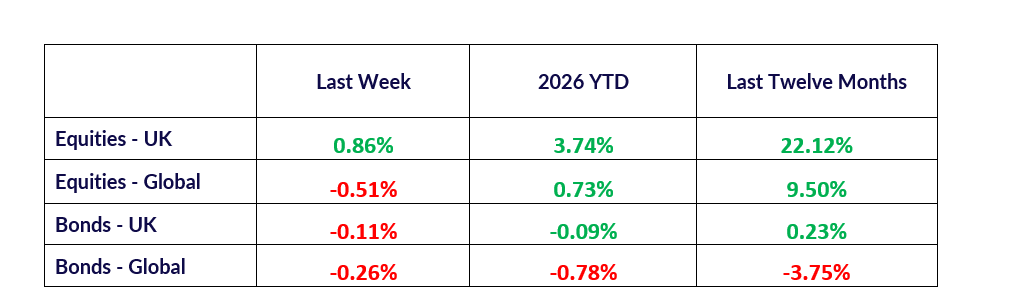
The performance of each asset class is represented by certain Exchange Traded Funds available to UK investors and expressed in GBP terms selected by Copia Capital Management to represent that asset class, as reported at previous Thursday 4:30pm UK close. Reference to a particular asset class does not represent a recommendation to seek exposure to that asset class. This information is included for comparison purposes for the period stated but is not an indicator of potential maximum loss for other periods or in the future.