The infoshot to help kick-start your week
Interest rate decisions in the UK, Europe and Japan
Last week we got a perfect hat-trick of interest rate decisions from the Bank of England (BoE), European Central Bank (ECB) and Bank of Japan (BoJ).
As expected, particularly after inflation for November was shown to have fallen to 3.2% on Wednesday, the BoE decided to cut the base rate from 4% to 3.75%. However, the vote was tight with four members of the bank’s committee voting against the reduction. The Bank’s governor, Andrew Bailey said “We still think rates are on a gradual downward path” but “with every cut we make, how much further we go becomes a closer call.”
By a unanimous decision, the ECB kept its benchmark interest rate at 2% for the fourth month in a row. They upgraded growth forecasts from 1.2% to 1.4% and raised their 2026 GDP forecast from 1% to 1.2%. ECB president, Christine Lagarde said “The economy had been resilient” in the face of Trump’s tariffs and that domestic demand is likely to remain the “main engine of growth in the years ahead.” She also said “all options should remain on the table” for interest rates going forward.
On Friday, the BoJ opted to raise its main interest rate from 0.5% to 0.75%. The new rate is the highest level since 1995. Prime Minister Sanae Takaichi will be hoping the move increases the value of the yen to help combat inflation. In November inflation rose to 3% according to the latest figures, above the BoJ’s target rate of 2%.
Silver and gold reach record highs
Silver reached an all-time high of $66.50 an ounce on Wednesday. As I write this morning it’s nearing $69 an ounce, and in the last month it’s now risen by more than a quarter. Concerns over its supply, potential US war with Venezuela (last week Trump ordered a “total” blockade of oil tankers coming in and out of Venezuela) and the increased likelihood of lower US interest rates have propelled the surge. Gold was a bit behind last week, but this morning it has gone above $4,400 an ounce for the first time.
2025 data centre spending surpasses 2024
A new report from S&P Global showed a record-breaking $61bn has been spent so far this year on data centre investments across the globe. The 11-month figure for this year exceeds the $60bn that was spent in 2024. It’s been fuelled by a mix of ‘hyper scalers’ like Meta and Alphabet, private equity investment and debt financing. According to Market Intelligence, debt issued to data centre owners and operators has nearly doubled this year to $182bn. US-based firms have driven the staggering rise by increasing their debt issuance from $38.7bn in 2024 to $135bn in 2025.
There was more bad news for Oracle last week when its largest data centre partner, the UK based Blue Whale Capital, decided to pull out of a $10bn deal to back a planned 1gigawatt data centre for OpenAI in Michigan. Oracle shares took a hit following the news, but they bounced back on Friday after it was reported that Oracle, alongside private equity firm Silver Lake and Abu-Dhabi’s MGX, are set to take ownership of around 45% of TikTok’s US business.
In other AI-energy related news, on Thursday, Trump Media and Technology Group (TMTG), who own Truth Social, announced a $6bn 50:50 merger with fusion power company, TAE Technologies. They’re planning to start building, “the world’s first utility-scale fusion power plant” next year in an attempt to use nuclear fusion to power AI data centres.
Coming Up:
- UK GDP, Monday 22 December 2025
- US Core PCE Price Index, Monday 22 December 2025
- US GDP Q3, Tuesday 23 December 2025
Notice:
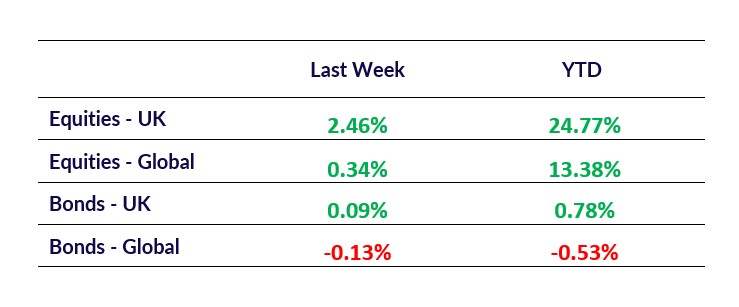
For regulated financial advisers and investment professionals only, Copia does not provide financial advice, and the contents of this document should not be taken as such. The performance of each asset class is represented by certain Exchange Traded Funds available to UK investors and expressed in GBP terms selected by Copia Capital Management to represent that asset class, as reported at previous Thursday 4:30pm UK close. Reference to a particular asset class does not represent a recommendation to seek exposure to that asset class. This information is included for comparison purposes for the period stated but is not an indicator of potential maximum loss for other periods or in the future.