The infoshot to help kick-start your week
Coming up this week:
Federal Reserve meeting – Wednesday
While holding rates is still expected, the chances of a rate hike at this week’s Federal Reserve meeting have increased in recent weeks. Renewed tensions in the Middle East have elevated energy prices once again and the demand for AI infrastructure is only adding to the inflation problem in the US. US bond yields have been rising over inflation concerns, with the two-year yield (seen as the best indicator for future Fed interest rate policy) sitting above 4% since mid-May, indicating that bond markets anticipate a rate rise sometime this year.
Committees for the Bank of England (BoE) and Bank of Japan (BoJ) will also meet this week. Both are widely expected to keep rates unchanged.
Earnings from Microsoft, Meta, Amazon and Apple – Wednesday & Thursday
We’ve got more tech heavyweights reporting their quarterly results this week. Capital expenditure and revenue from AI activity will yet again be closely scrutinised by investors.
Last week:
Burnham gets some good news in week on as PM
New Prime Minister Andy Burnham received some positive economic data in his first week as PM. 10-year gilt yields eased to 5.07% on the back of news that retail sales rose 1% in June, beating expectations of a 0.3% decline. The World Cup and consistent sunshine helped contribute to the extra spending. Consumer confidence is now at a six-month high too. PMI data also showed UK business activity has returned to growth.
Counter to press expectations, Andy Burnham named John Healey as Chancellor. Healey resigned as Defence Secretary just six weeks ago in a row over military spending. UK defence stocks like Babcock and BAE surged on the news and the likelihood that Healey will increase defence spending from 2.7% to 3%.
Burnham announced an array of spending plans in week one as he tries to hit the ground running, including a pledge to end rough sleeping in England, cutting VAT from domestic electricity bills, a £2 cap on bus fares and a cut in business rates for pubs. This first set of pledges come in at just 0.1% of public spending. Burnham’s long-term aims to reform social care, expand council house building and raise the personal allowance will need to be set out in the budgets to come.
More problems for big tech
Big tech had another bad week as Alphabet and Tesla came under fire for their capex spending and questionable returns from AI investments.
Despite overall revenues increasing to $119.8bn (23% up on the same period last year) and Google Cloud revenue surging 82% year on year, Alphabet reported negative free cash flow (-$5.9bn) for the first time in more than a decade. Growing capex, pretty much of all which is being spent on AI-related projects and infrastructure, caused the negative turn, spooking investors and sending the share price down nearly 7%. Tesla also reported negative free cash flow of -$1.1bn as they continue to ramp up their spending. They plan to nearly treble their 2025 capex spend to $25bn. With major question marks lingering over when, if ever, Optimus robots or Robotaxis will generate returns, the latest report sent the share price tumbling 14.5% on Thursday.
In other worrying news regarding some US tech giants, research from Japanese finance newspaper, Nikkei Asia, found that Meta, Oracle, Amazon, Microsoft and Alphabet have a combined $1.65tn in AI investment debt that they’ve been keeping off their official balance sheets. These hidden liabilities have primarily been used to fund data centre build outs. While not technically illegal, the scale of the debt and the growing concerns about AI profitability will be concerning investors. To give the numbers some perspective: $1.65tn exceeds the $1.35tn in debt that they’ve been reporting on official balance sheets; Meta’s off-balance-sheet debt of $420bn is three times higher than its reported debt; and Oracle’s off-balance-sheet commitments have increased 30 fold in the last four years.
US Trade Department finds a workaround for Trump’s tariffs
Trump’s tariffs morphed into a different guise on Thursday. The US imposed new tariffs on 60 countries to replace the levies that had to expire on Friday following the Supreme Court’s ruling in February that they were imposed illegally using the Emergency Powers Act. The White House are using “failures” to tackle forced labour as justification for the latest tariffs. The 10% to 12.5% duties will cover 99.4% of US imports according to the Office of US Trade.
One of the goals of Trump’s tariff policies has been to reinvigorate American manufacturing, however the latest data shows that since his re-election the US has lost 75,000 manufacturing jobs. Over the same period his predecessor Joe Biden created 625,000 new jobs in the sector.
Oil breaks the $100 a barrel barrier again
The return to hostilities in Iran pushed oil prices above $100 a barrel after Yemen’s Houthis announced a “maritime embargo” against Saudi Arabia. The Houthis said they would close the Bab al-Mandab Strait, the main Red Sea gateway for Saudi vessels. In response to the situation in Hormuz, more than 70% of Saudi exports have been diverted via the Red Sea with total petroleum volumes transiting through Bab al-Mandab reaching 7% of global output. Yesterday, the number of vessels passing through Bab al-Mandab fell to its lowest level in months with just 11 ships passing through.
Oil prices have however fallen today by as much as 9% after the US halted their attacks on Iran for a second night to give “talks some space”.
Notice:
For regulated financial advisers and investment professionals only, Copia does not provide financial advice, and the contents of this document should not be taken as such.
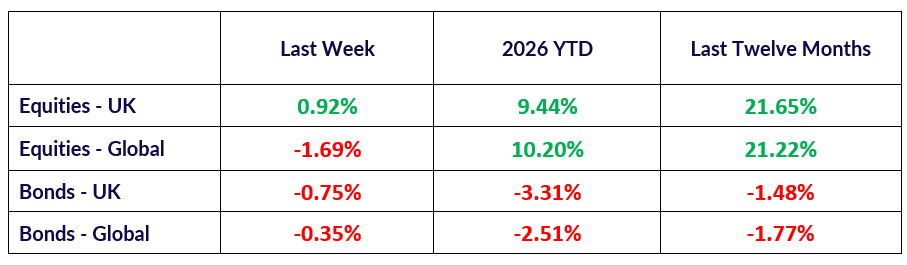
The performance of each asset class is represented by certain Exchange Traded Funds available to UK investors and expressed in GBP terms selected by Copia Capital Management to represent that asset class, as reported at previous Thursday 4:30pm UK close. Reference to a particular asset class does not represent a recommendation to seek exposure to that asset class. This information is included for comparison purposes for the period stated but is not an indicator of potential maximum loss for other periods or in the future.