The infoshot to help kick-start your week
Coming up this week:
Starmer steps down – Today
As I write this morning, Prime Minister Sir Keir Starmer has just announced his resignation. Following Andy Burnham’s resounding victory in the Makerfield by-election last week, he is expected to take over the reins. This week we’re likely to find out whether he’ll have to fight a full leadership contest or be elected PM without challenge. Potential contender, Wes Streeting has already come out and backed Burnham, simplifying Burnham’s path to number 10.
In the weeks and months ahead, investors will be keeping a keen eye on who Burnham appoints as Chancellor, any plans to deviate from the current fiscal limits, and whether he can repeat his Manchester growth story on a national level. Widely seen as the UK’s fastest growing city, Manchester’s economy has grown by 28% since 2015, more than double the national rate.
US-Iran talks continue – all week
Peace talks that were scheduled for Friday were delayed after Israel and Hezbollah started exchanging fire again. On Saturday, the Strait of Hormuz was shut by the Iranians after Israeli strikes on Southern Lebanon killed 47 people. In-person negotiations between senior officials started yesterday and lower-ranked officials will continue talks this week. The US and Iran have agreed to a roadmap for finalising a deal within 60 days. The US Treasury is preparing to issue a 60-day wavier of sanctions on Iran, meaning they could sell oil in the meanwhile without the threat of repercussions. Iran’s Foreign Minister, Abbas Araghchi, said yesterday, “the elimination of the conflict in Lebanon [is] the first real test”, and it looks like the success of week one will come down to whether Israel and Hezbollah can show restraint in Lebanon.
Last week:
Interest rate decisions
We had a trio of important interest rate decisions last week. All went as expected.
The Federal Reserve held US interest rates following Kevin Warsh’s first meeting as Fed Chair. With inflation at 4.2% and no real certainty around when a deal with Iran will be concluded, all twelve members of the committee voted to keep rates the same. Interestingly, the Fed released each committee member’s (aside from Warsh’s) predictions for rate changes this year and nine members expected at least one rate increase. In a TV interview, Trump repeated his desire for rate cuts but said Warsh, “is fantastic, and I want him to do whatever he wants.” During Wednesday’s press conference, Warsh declined to say whether he had met with Trump since becoming Chair.
Here in the UK, the Bank of England also elected to keep its benchmark interest rate the same for a fourth time in a row. The Bank’s Governor, Andrew Bailey, said he was encouraged by recent oil price falls but that the war meant “Whatever happens in the future, the higher energy prices of the past four months mean there’s already some inflationary pressure in the pipeline.” Two of the nine committee members voted to increase rates to 4%. Analysts are now favouring no rate changes before the end of the year but will be wary of all the current geopolitical and domestic uncertainty.
On Tuesday, Japan’s main interest rate was raised to a 31-year high of 1%. The Bank of Japan felt forced to react to higher energy prices and their knock-on effect on inflation. It’s the second rate rise since Sanae Takaichi became Prime Minister. Her drive to boost spending in the country has led to her dismissing the idea of hikes in the past. However, so far, she hasn’t expressed any criticism for the Bank’s decisions as they try to combat inflation.
Tech stocks rebound following Intel-Apple deal
US tech stocks rallied last week after the news of a chip-production deal between Intel and Apple lifted both firms and the broader market. Announced by Trump on Thursday, Intel will start manufacturing chips for Apple in the US, helping them diversify their manufacturing base and become less reliant on Taiwanese companies. The US government took a 10% stake in Intel last August.
Ahead of their upcoming IPO, OpenAI’s financials were leaked to independent journalist and blogger Ed Zitron. Verified by the FT, the numbers showed that despite net revenue tripling to $13.1bn in 2025, the company lost $38.5bn. The losses were exacerbated by the company’s change from a non-profit to a for-profit. But to put them in perspective they’re more than double the infamous losses incurred by Meta’s virtual reality division, Reality Labs, in 2024. In other IPO news, don’t expect the recently floated SpaceX to appear in any ESG funds after it was awarded the lowest possible ESG rating of CCC by MSCI. The report cited governance and sustainability concerns and placed SpaceX in the same rating category as Russia after the invasion of Ukraine.
Notice:
For regulated financial advisers and investment professionals only, Copia does not provide financial advice, and the contents of this document should not be taken as such.
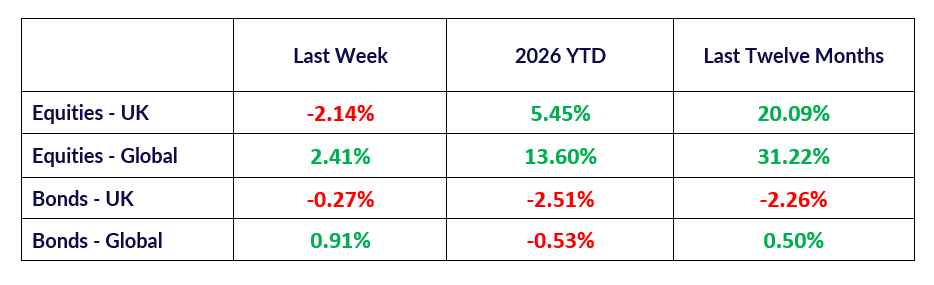
The performance of each asset class is represented by certain Exchange Traded Funds available to UK investors and expressed in GBP terms selected by Copia Capital Management to represent that asset class, as reported at previous Thursday 4:30pm UK close. Reference to a particular asset class does not represent a recommendation to seek exposure to that asset class. This information is included for comparison purposes for the period stated but is not an indicator of potential maximum loss for other periods or in the future.